
 6 months ago
178
6 months ago
178
A 40,000-year-old figurine, unearthed in a German cave in 1979, is offering fresh insight into the cognitive abilities of Europe's earliest distinct cultures. The "Adorant figurine," crafted from mammoth ivory and depicting a hybrid lion-human, bears intriguing sequences of notches and dots, marks also found on other artefacts from the same period.
New research suggests these markings, while not a written language, display properties akin to an early script that emerged much later in ancient Mesopotamia, around 3300 BC. This system was a forerunner to cuneiform, one of the world's oldest known forms of writing.
This discovery highlights the remarkable intellectual capacity of these ancient people. The artefacts date from a time when Homo sapiens spread across Europe as hunter-gatherers after migrating from Africa, encountering Neanderthals.
The researchers use the term sign types to describe these marks, which include notches, dots, lines, crosses, star shapes and some others. They conducted a computational analysis of their use on these artifacts for a trait called information density. This concept refers to the amount of information conveyed per unit of language, like a syllable or in this case a sign.
"We would argue that these sign sequences go beyond decoration that was aesthetically pleasing to particular individuals. Namely, our statistical results show that these signs were applied selectively and conventionally," said linguist Christian Bentz of Saarland University in Germany, lead author of the research published this week in the scientific journal Proceedings of the National Academy of Sciences.
For example, crosses were found only on tools and animal figurines, but not on human figurines.
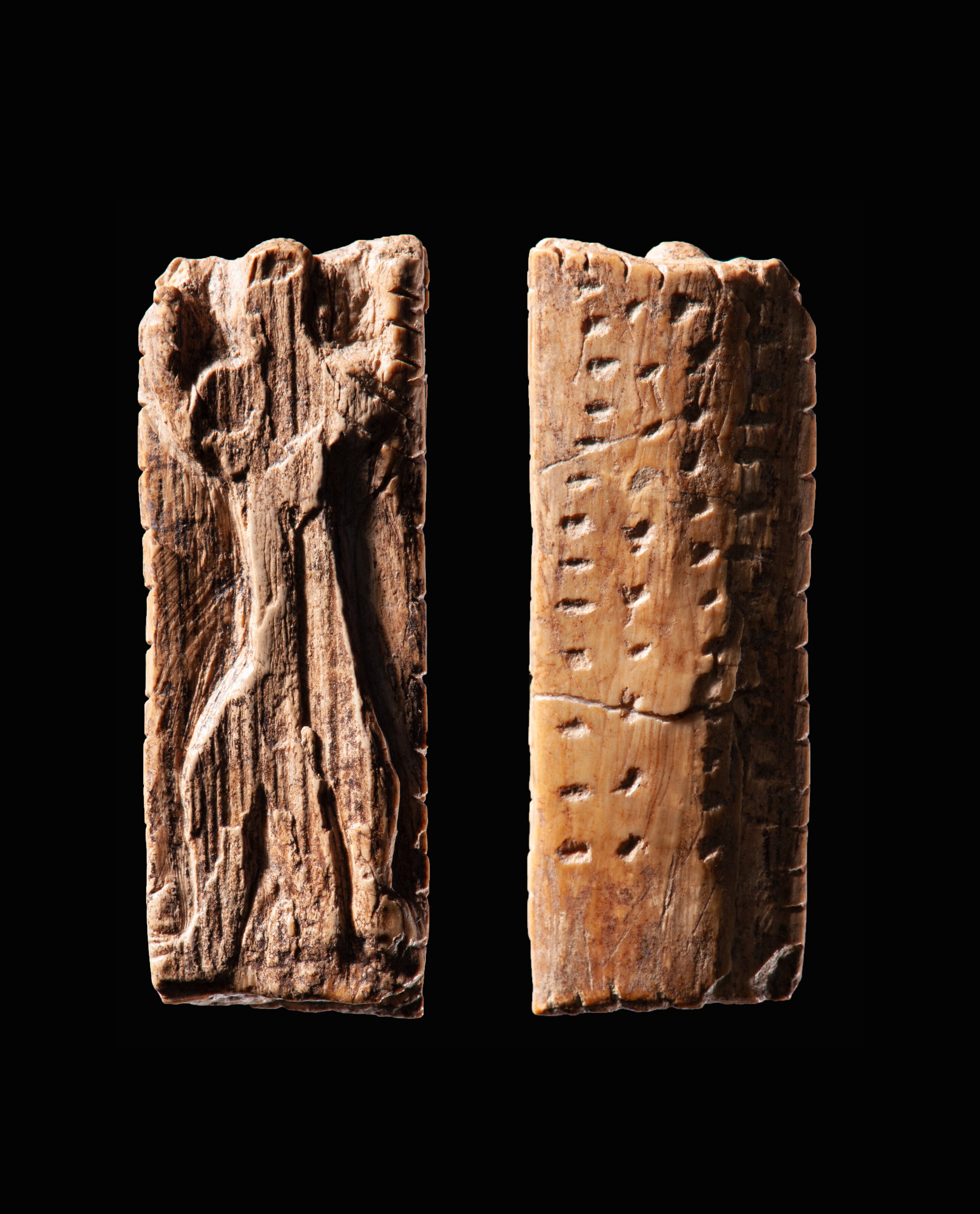
The researchers analyzed more than 200 Stone Age artifacts that bore these signs, dating from about 43,000 to 34,000 years ago, from four cave sites in southwestern Germany associated with a culture called the Aurignacian. The Adorant figurine, for instance, came from Geissenklösterle Cave in Germany's Baden-Württemberg state, and measured about 1-1/2 inches (38 mm) by half an inch (14 mm).
"The convention to carve certain sign types only into surfaces of certain artifacts must have been handed down over many generations, otherwise we would not find these statistical patterns in the data," Bentz said.
The goal of the researchers was not to determine the meaning of the signs, which still have not been deciphered.
The Aurignacian culture is associated with some of the oldest-known figurative art. The artifacts analyzed in the research mostly were made of ivory from mammoth tusks, but also from animal bones and antlers. Some of the figures were of animals including mammoths, cave lions and horses as well as creatures apparently blending human and animal traits. There also were various tools, personal ornaments and musical instruments in the form of flutes.
The researchers found that the sign sequences they analyzed were statistically different from modern-day writing systems.
But they found that these sign sequences displayed an information density very similar to the earliest examples of the cuneiform forerunner called proto-cuneiform, known from the ancient Mesopotamian city of Uruk. Proto-cuneiform evolved into cuneiform, a system of writing employing wedge-shaped marks that was used for millennia in the ancient Near East.
The researchers said the Aurignacian signs display some design features found in written languages but that other features are missing including the connection to spoken language structures.
"We can only speculate about the status of spoken languages at the time. In general, archaeologists and linguists would certainly assume that modern humans (Homo sapiens) 40,000 years ago had spoken languages structurally similar to those spoken around the world today," said archaeologist and study co-author Ewa Dutkiewicz of the Museum of Prehistory and Early History in Berlin.











 English (US) ·