
 5 hours ago
55
A US federal judge clears two MIT-educated brothers accused of extracting approximately $25 million from Ethereum trading bots, bringing an end to the government’s first criminal prosecution involving a major maximal extractable value (MEV) exploit.
US District Judge Jessica Clarke ruled on November 16 that prosecutors failed to establish the material misrepresentation required to prove wire fraud against Anton and James Peraire-Bueno. The decision also cleared the brothers of conspiracy to commit wire fraud and conspiracy to commit money laundering.
The ruling closes a case that began with allegations of a sophisticated trading operation carried out in April 2023 and follows a mistrial in November 2025, when jurors failed to reach a unanimous verdict.
Clarke described Ethereum as a “trustless, highly adversarial environment with no terms of use,” highlighting the legal challenges involved in determining whether exploiting weaknesses in blockchain infrastructure amounts to criminal fraud.
How the Brothers Extracted $25 Million From Ethereum Trading Bots
According to the court’s opinion, the brothers targeted automated trading bots that monitor Ethereum’s public transaction queue, known as the mempool. These bots attempt to generate profits through maximal extractable value, or MEV, by identifying opportunities to influence the order in which transactions are processed.
One common strategy is called a sandwich attack. A bot detects a pending large purchase, buys the same asset beforehand and sells after the original transaction pushes its price higher. Prosecutors alleged that the Peraire-Bueno brothers used eight bait transactions in April 2023 to attract these automated strategies.
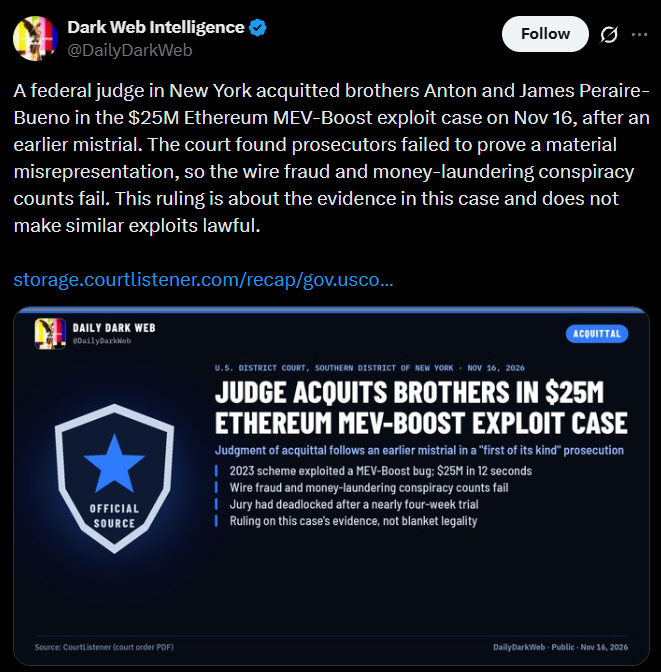 Dark Web Intelligence on X
When their validator was selected to process a block, they exploited a weakness involving the Ultrasound relay. The validator signed a block header containing two fields set to zero, describing a block that could not be valid. However, the relay failed to verify those fields and disclosed the transactions inside.
The brothers then constructed their own block, preserving the bots’ purchases while replacing the bait transactions with sales that pushed prices lower. By the time the bots attempted to exit their positions, the brothers had already completed their trades.
The operation generated approximately $25 million in losses for the targeted bots within 12 seconds. Meanwhile, the brothers’ validator received a penalty of around 1 ETH.
Why the Judge Ruled the Ethereum MEV Operation Was Not Wire Fraud
The central issue in the case was whether the brothers had made a material misrepresentation that another party relied upon. Judge Clarke concluded that prosecutors had not established this essential element of wire fraud. She rejected the argument that placing transactions in Ethereum’s public mempool created an implicit agreement that those transactions would be processed alongside others in a particular order.
The judge also found that the falsified block-header fields did not establish fraud because the relay never checked them. As a result, the information did not influence the relay’s behavior.
Clarke acknowledged that the brothers concealed their intentions and may have violated the spirit of the relay software’s design. However, she emphasized that conduct being improper or objectionable does not automatically make it criminal under the charges brought by prosecutors.
The decision therefore addresses the specific fraud allegations rather than establishing that every form of MEV exploitation is legally permissible.
$25 Million Ethereum Case Ends After 2025 Mistrial
The acquittal follows a November 2025 trial that ended without a verdict after jurors could not agree on the brothers’ guilt. Clarke’s latest judgment directs the court clerk to close the case, ending the federal prosecution without another trial.
The financial outcome of the operation also remains notable. According to the court proceedings, only one wallet containing approximately $3 million of the proceeds was frozen, while the brothers had moved the remaining funds by October 2023.
The ruling could become an important reference point in future legal disputes involving MEV, automated trading strategies and the boundaries of criminal liability in decentralized networks. However, it does not resolve broader questions about the ethical implications of sandwich attacks or the responsibilities of participants operating blockchain infrastructure.
Do you think the ruling creates greater legal uncertainty around MEV trading on Ethereum? Could future prosecutors face similar challenges when pursuing cases involving sophisticated blockchain exploits?












 English (US) ·